TL;DR
In short
- The Land Registry, or more specifically HM Land Registry (HMLR), is a government agency operating in England and Wales.
- The regulations require that all property transactions be recorded in the Land Registry, and if the property has not yet been included in the register, this should be done as soon as possible.
- A register entry (register title) can be compared to a page in a book that lists a set of specific information.
- Land Registry fees are generally based on the value of the transaction you are making.
- HMLR boasts on its website thatover 80% of applications are processed within one day.
If you decide to purchase property in the UK, sooner or later you will learn about the need to register with the Land Registry. Although registration is usually carried out by asolicitor or conveyancer, it is worth being at least somewhat aware of how the entire process works and how the regulations affect your ownership status.
What is Land Registry?
The Land Registry, or more specifically HM Land Registry (HMLR), is a government agency operating in England and Wales. Its task is to maintain the official register of land and property ownership. The Land Registry also keeps records containing information about other rights to houses and flats. Therefore, if a property is mortgaged, this will be disclosed in the HMLR.
If you arebuying a house in Scotland, your registry will be Registers of Scotland. Properties in Northern Ireland are registered with Land and Property Services.
Why is the Land Registry maintained?
The regulations require that all property transactions be recorded in the Land Registry, and if the property has not yet been included in the register, this should be done as soon as possible. Any event relating to a house or flat (establishment of a leasehold, establishment of a trust, sale, inheritance) must be reported to the HMLR within 30 days of the event giving rise to this obligation, for example from the date of completion or the establishment of a mortgage.
The Land Registry is maintained primarily to ensure the highest possible level of security in real estate transactions. As the HMLR contains information on all rights related to a given plot of land or house, both owners and their creditors (e.g. banks) are provided with additional protection. The boundaries of plots of land and any information about the risk of flooding are also recorded. Such official registers are kept all over the world, and their purpose is essentially always the same.
Unlike many other legal systems, you become the owner of the property on the date of completion (when you receive the keys), not when the entry is made in the Land Registry. The change in the content of the land register is therefore a declaration of the actual state of affairs, not the creation of a new situation.
What does an entry in the Land Registry contain?
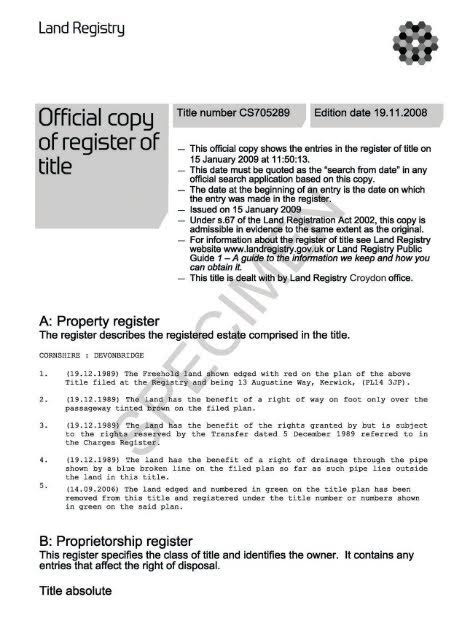
A register entry (register title) can be compared to a page in a book that lists a set of specific information. The most important of these include:
-
Title number – unique serial number of the property;
-
**Property register **- description of the property including information about the address, access road, plot boundaries;
-
Proprietorship register - information about the property owner, type of ownership (freehold, leasehold), restrictions on sale;
-
Charges register - in this part of the entry you will find information about encumbrances on the property. These are primarily mortgages, but also easements.
How much does it cost to register with the Land Registry?
Land Registry fees are generally based on the value of the transaction you are making. However, it should be noted that, unlike Stamp Duty Land Tax, the fee is not divided into parts – if you are buying a house for £600,000, you will pay the fee for that price bracket (in this case, £655).
Scale 1 fees
These are fees for acquiring new property or new rights, and are therefore charged, for example, when purchasing a house or flat, establishing a leasehold, or registering a property for the first time.
Value Application sent by post Application sent by solicitor Application sent by a solicitor, but concerning only part of the entry Voluntary first registration From 0 to £80,000 £45 £20 £45 £30 From £80,001 to £100,000 £95 £40 £95 £70 From £100,001 to £200,000 £230 £100 £230 £170 From £200,001 to £500,000 £330 £150 £330 £250 From £500,001 to £1,000,000 £655 £295 £655 £ 495 From £1,000,001 upwards £1,105 £500 £1,105 £830 Source: gov.uk
Scale 2 fees
Scale 2 fees cover, among other things, donations, transfers of shares, transfers of real estate through trusts – these are changes in existing ownership (modifications to legal status).
** Value** ** Application sent by post** ** Application sent by solicitor** ** Application sent by a solicitor, but concerning only part of the entry** From 0 to £80,000 £45 £20 £45 From £80,001 to £100,000 £70 £30 £70 From £100,001 to £200,000 £100 £45 £100 From £200,001 to £500,000 £145 £65 £145 From £500,001 to £1,000,000 £305 £140 £305 Source: gov.uk
It is therefore easy to see that, as a rule, it is more cost-effective to submit applications to the Land Registry through a solicitor rather than on your own. This is because documents sent via the government portal are easier to process. It also means that you will get your entry faster if you do not use the postal service. In the vast majority of cases, the fee for making an entry in the HMLR is already included in the solicitor’s fee.
Entries from the books
It is worth noting that the Land Registry is a public register – everyone has the right to obtain the information contained therein. You can request a copy of the Title Register and the Title Plan. The price is £3 per document, which is a small fee compared to the benefits of having access to such a large amount of data. You can generate copies of the registershere.
How long does it take to obtain an entry in the Land Registry?
HMLR boasts on its website thatover 80% of applications are processed within one day. However, when we look at the statistics on changes to existing titles, it turns out that one in three people have to wait more than three months for an administrative decision. Interestingly, approximately 37,000 applications per month are classified as ‘Complex change’, and their processing can take up to 18 months.
In practice, however, you will receive an extract from the Land Registry approximately 2-6 weeks after submitting your application. Once the process is complete, a** Title Information Document** will be issued.
Unregistered property
It is worth mentioning properties that are still unregistered. Although the Land Registry has been in existence for over 100 years, in 2022 it was estimated that around 12% of properties were still unregistered.
Let’s be clear – it is still possible to buy an unregistered house in the UK, although it is very unlikely. However, if you do come across such a property, you must be prepared for a lot of formal problems and significantly higher conveyancing costs. Although the official fee will still not be high, the process of establishing ownership of the plot/house becomes very complicated.
Our experience shows that purchasing unregistered property in the UK only makes sense if the price is significantly lower – legal fees can reach several thousand pounds, and the formalities can take up to two years. The complicated legal situation may also affect the availability of credit – most banks will not want to finance such a property because without an entry in the Land Registry, it will not be possible to establish a mortgage.
Summary
When deciding to purchase property in the UK, you will almost certainly not encounter any problems with the Land Registry – by 2025, the system is already working very efficiently. Although your solicitor should take care of everything, you should definitely keep an eye on matters related to obtaining registration.
Are you planning to buy a house in the UK? Do you have questions about mortgages? Contact us – we can help.
FAQ
Frequently asked questions
What is Land Registry?
The Land Registry, or more specifically HM Land Registry (HMLR), is a government agency operating in England and Wales.
Why is the Land Registry maintained?
The regulations require that all property transactions be recorded in the Land Registry, and if the property has not yet been included in the register, this should be done as soon as possible.
What does an entry in the Land Registry contain?
A register entry (register title) can be compared to a page in a book that lists a set of specific information.
How much does it cost to register with the Land Registry?
Land Registry fees are generally based on the value of the transaction you are making.
How long does it take to obtain an entry in the Land Registry?
HMLR boasts on its website thatover 80% of applications are processed within one day.