
TL;DR
In short
- This is a snapshot of the UK property market in winter 2025, based on data published up to January 2025.
- The official UK House Price Index put the average UK house price at £290,000 in November 2024, 3.3% higher than a year earlier.
- Rightmove tracks asking prices, while Nationwide and Halifax use prices from their own mortgage approvals, so their figures differ.
- Bank Rate was 4.75% in January 2025, after cuts in August and November 2024.
- From 1 April 2025, Stamp Duty Land Tax thresholds in England and Northern Ireland fell, including first-time buyer relief.
This article is a snapshot of the UK property market in winter 2025. It uses data published up to January 2025 and has not been updated with later figures, so check the latest UK House Price Index, Bank of England and GOV.UK pages for current numbers.

What was happening to property prices at the start of 2025?
How do we know what current property prices are?
Let’s start with some basic facts. First and foremost, property prices are dynamic - buyers adjust to a volatile market on an ongoing basis, while negotiations between the parties to the transaction are possible at the purchase stage. Unlike in 2023, inflation was no longer as high, but interest rates were still much higher than buyers had been used to. Official prices are published in the UK House Price Index, produced by HM Land Registry with the ONS and other partners.
According to the UK House Price Index for November 2024 (the latest available in January 2025), the average UK house price was £290,000. Prices were 3.3% higher than a year earlier and 0.4% lower than in October 2024.
Asking prices rose at the start of the year. Rightmove reported in January 2025 that the average asking price of property coming to market rose by 1.7% to £366,189, from £360,197 in December 2024. Note that the UK House Price Index figures above are for completed sales of all property types, while Rightmove reports asking prices. Official UK House Price Index figures are published monthly, about two months after the month they cover, which is why asking-price data from property portals appears sooner.
Where else can we get data from?
For more localised analysis, we can use ad portals like Rightmove and Zoopla. Not only will you find tools and reports on the locations you are interested in on these sites, it is worth simply analysing the database of current listings - a useful indicator of the market situation. While we are on the subject of offers, it is worth recalling our article explaining how to increase the value of a property when selling. At the bottom of the post, you will find more information about online valuation tools.
You can also ask your real estate agent and mortgage broker about current property prices, although it’s fair to say that no one will give you a very precise answer. Such statistics are usually public, and an analysis of our recent transactions may not be the most accurate, after all, we operate on a small scale for the entire market. Of course, any broker will tell you that real estate prices have been fluctuating for the last year, but giving specific figures would already be very difficult.
At the end of 2024, average prices were changing only gradually from month to month. While this is of great importance to buyers, without in-depth analysis it will be difficult to realise that something has changed. Announcements are constantly changing, and the differences in prices are not large enough for the market to experience rapid changes. If the average dropped by £50,000, you would certainly hear about it in the media.
Will UK property prices fall?
Official prices dipped slightly in November 2024 (0.4% lower than in October) but were still higher than a year earlier. Does this mean that there will be a crash, and houses can be bought for a fraction of the price? We did not think so, although further gentle declines were possible. According to the ONS, CPI inflation was 2.5% in the 12 months to December 2024, up from 2.0% in May 2024. Sellers’ expectations were also changing. In our view at the time, prices were unlikely to keep rising quickly, but we did not expect a sharp fall either. A lower consumer inflation rate does not itself mean that prices return to an earlier level. House prices follow their own market conditions and can rise or fall, so consumer inflation alone does not establish their future path.
Government schemes can also affect demand for homes in the UK. Last year we wrote about the end of the Help to Buy program, which was very popular among our clients. The end of the scheme may have led some potential buyers to put their plans on hold.
If you have little or no savings, read our guide to no deposit mortgages to see what may be possible.
To sum up, at the start of 2025 we did not expect drastic price falls, although prices could still dip. This was our opinion at the time, and the market can always surprise.
And what has been happening in the UK property market over the past years and months?
The chart below shows how average UK property prices changed between 2007 and 2024. The sharp rise in the number of transactions in mid-2021 coincided with the phasing out of the temporary Stamp Duty reduction in England and Northern Ireland: many buyers tried to complete before 30 June 2021, when the £500,000 nil-rate band ended, and the reduced £250,000 nil-rate band then ran until 30 September 2021.
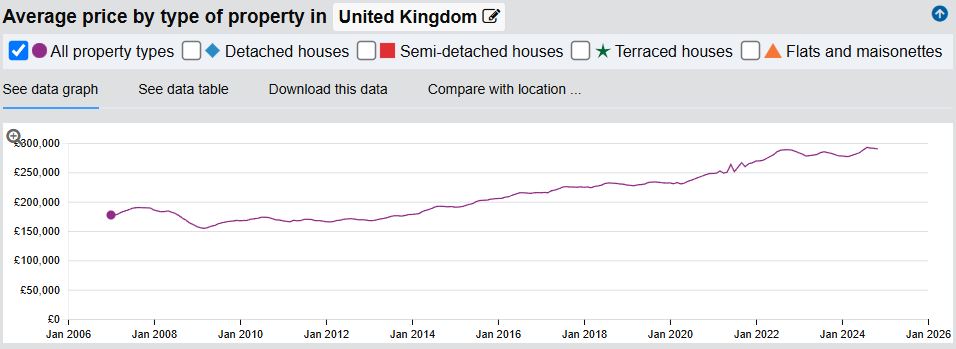
UK property prices between 2007 and 2024
Very interesting developments have taken place in terms of the number of transactions. According to HMRC’s data, the beginning of the pandemic marked a huge stagnation in the real estate market, which then resulted in a clear rebound in mid-2021.
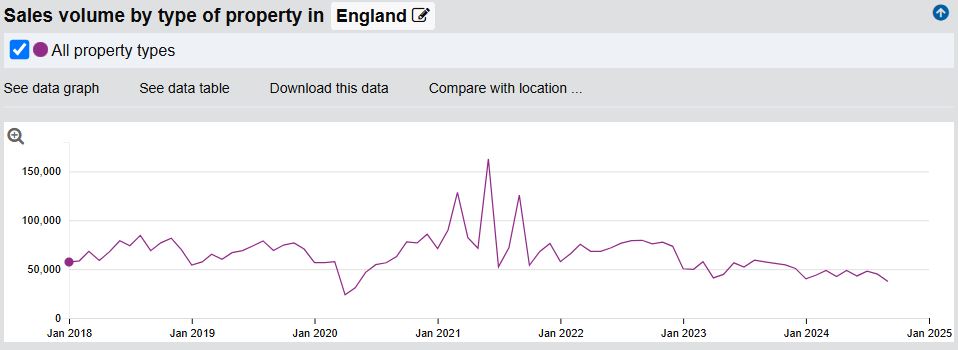
Monthly residential property sales volumes in England, 2018-2024 (UK House Price Index)
The Bank of England’s policy also matters. Bank Rate rose repeatedly through 2022 and 2023; the first increase, on 16 December 2021, took it from 0.1% to 0.25%. It peaked at 5.25% between August 2023 and August 2024. The first cut, to 5%, came on 1 August 2024, and a second cut on 7 November 2024 brought Bank Rate to 4.75%. That was still the level in January 2025, when this article was written. Bank Rate has changed since then, so check the Bank of England for the current rate.
UK property prices expressed in various indices
In addition to the official UK House Price Index, there are several other useful indices. Certainly the reports provided by Rightmove are a good tool, but it is important to remember that they are based on asking prices, not sale prices. Nationwide and Halifax also publish monthly indices, based on prices from their own mortgage approvals.
| Index | Month-on-month change | Year-on-year change |
|---|---|---|
| Rightmove (December 2024) | -1.7% | 1.4% |
| Nationwide (December 2024) | 0.7% | 4.7% |
| Halifax (December 2024) | -0.2% | 3.3% |
Changes in UK house prices across several indices (figures as first published in January 2025)
Where do the differences come from? Each index measures something different: Rightmove tracks the asking prices of homes coming to market, while Nationwide and Halifax use prices from their own mortgage approvals, so their samples and timing differ.
Is the UK real estate market accelerating?
At the start of 2025, some data pointed to a gradual recovery. More homes were coming up for sale, prices were rising only gently, and with mortgage rates still higher than in previous years, rapid price growth did not seem likely.
What about forecasts for 2025?
It’s worth remembering that forecasts can be wrong. For 2022, for example, Rightmove forecast that asking prices would rise by 5% nationally (source: Rightmove forecasts house prices to rise nationally by 5% in 2022), while Zoopla forecast a 3% rise (source: Zoopla - Housing Market in 2022).
This does not mean we should disregard analysts and specialists, but we recommend caution. None of us can predict the future.
Is now a good time to buy property in the UK?
This question comes up really often. No one can give you a definitive answer, but these were the most relevant facts at the start of 2025:
1. Mortgages with low deposits are still available
Some lenders offer mortgages with a 5% deposit (95% loan-to-value), subject to affordability and lending criteria; we cover this in our Q&A. A 5% deposit on a typical UK home is still a significant sum, and buying costs come on top. Rates on 95% loan-to-value mortgages are usually higher than with a larger deposit, but after a few years you may be able to remortgage to a potentially lower rate.
2. Stamp Duty Land Tax thresholds fell in April 2025
From 1 April 2025, the Stamp Duty Land Tax nil-rate threshold in England and Northern Ireland fell from £250,000 to £125,000. First-time buyer relief also changed: first-time buyers now pay no SDLT on the first £300,000 (previously £425,000), and the relief is not available on properties over £500,000 (previously £625,000). Scotland and Wales have their own taxes: Land and Buildings Transaction Tax and Land Transaction Tax.
3. Interest rates had started to fall
After the series of Bank Rate rises in 2021-2023, CPI inflation had fallen to 2.5% by December 2024, and the Bank of England had started cutting Bank Rate in August 2024. Lower rates can make mortgages more affordable, although each lender sets its own rates.
4. House prices had not fallen markedly
At the start of 2025 there was little evidence of a marked fall in prices: all three indices in the table above showed prices higher than a year earlier.
5. Rents had been rising
Private rents across the UK rose during 2024, according to the ONS. If you are weighing up renting against buying, compare the full monthly costs of both.
Whether real estate prices are falling or not, if you are considering a purchase, you are cordially invited to a consultation. Our credit counselors will not only check your current creditworthiness and select the right product for your needs, but also answer all your burning questions. And if you found this post interesting, why not share it with your friends or sign up for our newsletter to receive information about our new articles?
FAQ
Frequently asked questions
Where can I find official UK house prices?
The official source is the UK House Price Index, produced by HM Land Registry with the ONS and other partners. It is published monthly, about two months after the month it covers. Property portals such as Rightmove and Zoopla show asking prices and local listings sooner.
Why do house price indices show different figures?
They measure different things. Rightmove tracks the asking prices of homes coming to market, while Nationwide and Halifax use prices from their own mortgage approvals. The UK House Price Index is based on completed sales, so it is published later.
Were UK house prices falling at the start of 2025?
Not markedly. The UK House Price Index showed a 0.4% monthly dip in November 2024, but prices were still 3.3% higher than a year earlier. In December 2024, Rightmove, Nationwide and Halifax all showed prices higher than a year earlier.
What changed with Stamp Duty in April 2025?
From 1 April 2025, the SDLT nil-rate threshold in England and Northern Ireland fell from £250,000 to £125,000. First-time buyers now pay no SDLT on the first £300,000 (previously £425,000), and the relief is not available on properties over £500,000 (previously £625,000).
What was the Bank of England base rate in January 2025?
Bank Rate was 4.75% in January 2025, following cuts on 1 August 2024 and 7 November 2024. It has changed since, so check the Bank of England website for the current rate.