
TL;DR
In short
- Loan-to-value (LTV) is your mortgage as a percentage of the property’s value: LTV = loan ÷ property value × 100.
- Your deposit is 100% minus your LTV, so a 10% deposit means 90% LTV.
- Many lenders offer mortgages up to 95% LTV, and rates are usually priced in LTV bands; the lower your band, the better your chance of a lower rate.
- If the lender’s valuation comes in below the agreed price, your LTV will be higher than planned and you may need a bigger deposit or to renegotiate the price.
- Although such a question arises relatively rarely, from time to time we analyze with our clients whether it is worth paying a higher down payment.
LTV, or loan-to-value, comes up in almost every article about mortgages. That’s no surprise: this ratio can have a significant effect on the interest rate you are offered. Here’s what LTV means, how to calculate it and how to use it when planning your deposit.
What is loan-to-value (LTV)?

Loan-to-value (LTV) is the size of your mortgage as a percentage of the value of the property it is secured on. Your LTV is highest when you take out the mortgage and usually falls as you repay it, as long as the property’s value does not fall.
To calculate it, divide the loan by the property value and multiply by 100:
LTV = loan ÷ property value × 100
For example, a £225,000 mortgage on a £250,000 home is 90% LTV, which means a 10% deposit.
Which loans use LTV?
LTV is used mainly for mortgages, where the property is the security for the loan. That includes remortgages and second charge mortgages.
How does LTV affect your deposit?

Your deposit and your LTV are two sides of the same calculation: your deposit is 100% minus your LTV. A 5% deposit means 95% LTV, and a 10% deposit means 90% LTV.
LTV is worked out from the loan and the property value the lender accepts. If the lender’s valuation comes in below the agreed price (a down-valuation), your LTV will be higher than planned and you may need a bigger deposit or to renegotiate the price.
What LTV do UK mortgages usually have?
Many lenders offer mortgages up to 95% LTV, with rates usually priced in LTV bands. Lenders also offer products at lower LTV bands, such as 85%, 80%, 75% or 60%. The lower your LTV band, the better your chance of a lower rate.
If property prices fall, you can owe more than the property is worth (LTV above 100%). This is known as negative equity. The risk is higher when you borrow at a high LTV, and negative equity can make remortgaging or selling harder.
What LTV should my mortgage have?

Although such a question arises relatively rarely, from time to time we analyze with our clients whether it is worth paying a higher down-payment. Unfortunately, there is no simple answer.
The two examples below are simplified illustrations. They use example rates as at August 2024, not current offers, ignore fees and assume the property value stays the same.
Example 1:
Martha and Jacob want to buy a house worth £250,000 with a 25-year repayment mortgage and a 2-year fixed rate. They have £30,000 in savings and are comparing two example rates (as at August 2024): 5.89% at 95% LTV and 5.28% at 90% LTV. Which should they choose?
With a 5% deposit (£12,500, 95% LTV), the monthly payment would be £1,514.29. With a 10% deposit (£25,000, 90% LTV), it would drop to £1,352.29. That is £162 a month less, or £3,888 over the 2-year fixed period. This ignores fees, and the 90% option needs £12,500 more deposit.
Example 2:
Andrew and Michael want to buy a flat worth £400,000 and repay the mortgage over just 10 years. Selling their previous flat means they can put down up to £160,000. Andrew prefers certainty, so they are looking at 5-year fixed rates. Repaying a mortgage over such a short term needs a high income.
At example rates as at August 2024, a 60% LTV mortgage (£240,000 loan, £160,000 deposit) was priced at 4.14% and a 70% LTV mortgage (£280,000 loan, £120,000 deposit) at 4.37%. Over 10 years, that means monthly payments of £2,445.88 or £2,884.36 respectively.
Is a bigger deposit always better?

A bigger deposit means you borrow less, so your monthly payment falls. But because rates are priced in LTV bands, a bigger deposit lowers your rate only when it moves you into a lower band, and the difference between lower bands can be small. In the second example, a much larger deposit (£160,000 instead of £120,000) lowers the rate by just 0.23 percentage points, which is about £230 a year less interest per £100,000 borrowed.
It can sometimes make sense to accept a slightly higher rate and later remortgage or overpay. If you plan to do this, check early repayment charges, overpayment limits and fees, and bear in mind that remortgaging depends on the valuation and your affordability at the time.
Is a 95% LTV mortgage worth it?

A 95% LTV mortgage can help you buy sooner, but it usually means a higher rate, fewer products to choose from and more exposure if prices fall (negative equity). Whether it suits you depends on your circumstances.
Let’s go back to Martha and Jacob and the 95% LTV example at 5.89%. Using MoneyHelper’s mortgage calculator, on a £237,500 repayment mortgage at 5.89% over 25 years they would still owe about £228,645 after two years (about 91.5% of the original £250,000 value). So they would not reach the 90% band when the 2-year fix ends unless the property value had risen. After about three years, the balance (about £223,812) would fall below 90% of the original value. The table below shows the remaining balance by year:
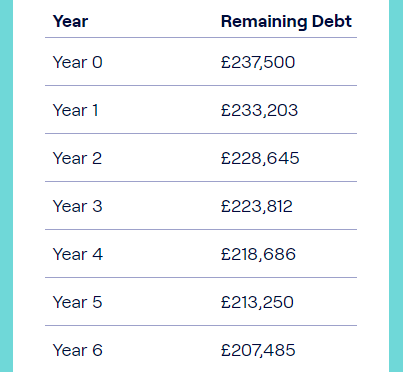
Once their LTV falls into a lower band, they may be able to remortgage to a lower rate, depending on the valuation, their affordability and any fees at the time.
Saving a larger deposit instead takes time, during which you may be paying rent. Weigh that against the higher cost and risks of borrowing at a high LTV.
Summary
Mortgages are our specialty. We help clients compare suitable options from the lenders available to us, taking account of their circumstances and the costs and conditions of each product. So if you are planning to buy a property and are looking for the best mortgage advisor who will explain every detail of your future deal in simple terms, don’t hesitate - Extend Finance will be an excellent choice.
FAQ
Frequently asked questions
What is loan-to-value (LTV)?
Loan-to-value (LTV) is the size of your mortgage as a percentage of the property’s value. To calculate it, divide the loan by the property value and multiply by 100: a £225,000 mortgage on a £250,000 home is 90% LTV.
Which loans use LTV?
LTV is used mainly for mortgages, where the property is the security for the loan. That includes remortgages and second charge mortgages.
How does LTV affect your deposit?
Your deposit is 100% minus your LTV, so a 10% deposit means 90% LTV. LTV is based on the property value the lender accepts, so if the valuation comes in below the agreed price, your LTV will be higher and you may need a bigger deposit or to renegotiate the price.
What LTV do UK mortgages usually have?
Many lenders offer mortgages up to 95% LTV, with rates usually priced in LTV bands such as 95%, 90%, 85%, 75% and 60%. The lower your LTV band, the better your chance of a lower rate.
What LTV should my mortgage have?
Although such a question arises relatively rarely, from time to time we analyze with our clients whether it is worth paying a higher down payment.
It depends on your savings, the rate difference between LTV bands, fees and how long it would take to save a bigger deposit. A bigger deposit lowers your rate only when it moves you into a lower band.