TL;DR
In short
- Bank Rate peaked at 5.25% in August 2023, its highest level since 2008. After a series of cuts, it was reduced to 3.75% in December 2025.
- On a fixed-rate deal, your monthly payment normally stays the same until the fixed period ends. On a tracker mortgage, payments can go up or down during the deal.
- According to the UK House Price Index, the average UK house price was £273,000 in July 2026, 1.4% higher than a year earlier.
- Whether buying makes sense depends on your circumstances, and house prices can fall as well as rise.
Buying a house will probably be the biggest expense of your life. It involves a lot of paperwork and is often also very stressful. One of the most important steps on the path to your own property is taking out a mortgage to finance the purchase. In this article, we look at interest rates, mortgage payments, house prices, purchase taxes and rents in the UK, and at the questions that can help you decide whether it’s worth buying a home.
Interest rates
Bank Rate is set by the Bank of England’s Monetary Policy Committee, which aims to keep inflation at the government’s 2% target.
Bank Rate was 0.1% from March 2020 until December 2021, when it started to rise. Bank Rate peaked at 5.25% in August 2023, its highest level since 2008. The first cut came in August 2024. After a series of cuts, Bank Rate was reduced to 3.75% in December 2025.
A mortgage is usually repaid over many years, and nobody can reliably predict how Bank Rate will change over that time.
How are mortgage instalments changing in the UK?
How a change in Bank Rate affects you depends on the type of mortgage you have. On a fixed-rate deal, your monthly payment normally stays the same until the fixed period ends, so a change in Bank Rate does not affect it until you move to a new deal. On a tracker mortgage, the rate usually follows Bank Rate plus a set margin, so payments can go up or down during the deal.
The interest rate directly affects the size of your monthly instalment. Illustration only (not a quote): on a £200,000 repayment mortgage over 25 years, a rate of 4% gives a monthly payment of about £1,056, while 5% gives about £1,169, roughly £114 a month more.
The size of your deposit also matters. A larger deposit means a lower loan-to-value (LTV), which can give you access to a wider range of deals and lower rates, although the rate you are offered also depends on your circumstances and the lender’s criteria.
Property prices
According to the UK House Price Index, the average UK house price was £273,000 in July 2026, 1.4% higher than a year earlier. You can read more in our article on house prices in the UK.

Stamp duty and other purchase taxes
When you buy a home, you may also have to pay a purchase tax, and which tax applies depends on where the property is. In England and Northern Ireland, Stamp Duty Land Tax (SDLT) on a main home is charged at 0% on the portion up to £125,000, 2% on £125,001 to £250,000, 5% on £250,001 to £925,000, 10% on £925,001 to £1.5 million and 12% above £1.5 million.
| Portion of the price | SDLT rate |
|---|---|
| Up to £125,000 | 0% |
| £125,001 to £250,000 | 2% |
| £250,001 to £925,000 | 5% |
| £925,001 to £1.5 million | 10% |
| Above £1.5 million | 12% |
First-time buyers in England and Northern Ireland pay no SDLT on the first £300,000 and 5% on the portion from £300,001 to £500,000; the relief is not available if the price is above £500,000.
Scotland has Land and Buildings Transaction Tax (LBTT) and Wales has Land Transaction Tax (LTT), with their own rates and reliefs. You can read more in our article on the changes to Stamp Duty Land Tax.
How have rents changed?
ONS figures put the average private rent in Great Britain at £1,327 a month in December 2024, £110 (9.1%) more than a year earlier. Check the latest ONS release for current figures.
When comparing renting with buying, it helps to set the rent you pay against the full costs of owning, using your own figures rather than national averages.
How does population change affect the UK housing market?
In the year to mid-2023, the UK population grew by 1.0% to an estimated 68.3 million, with net international migration the main contributor (ONS).
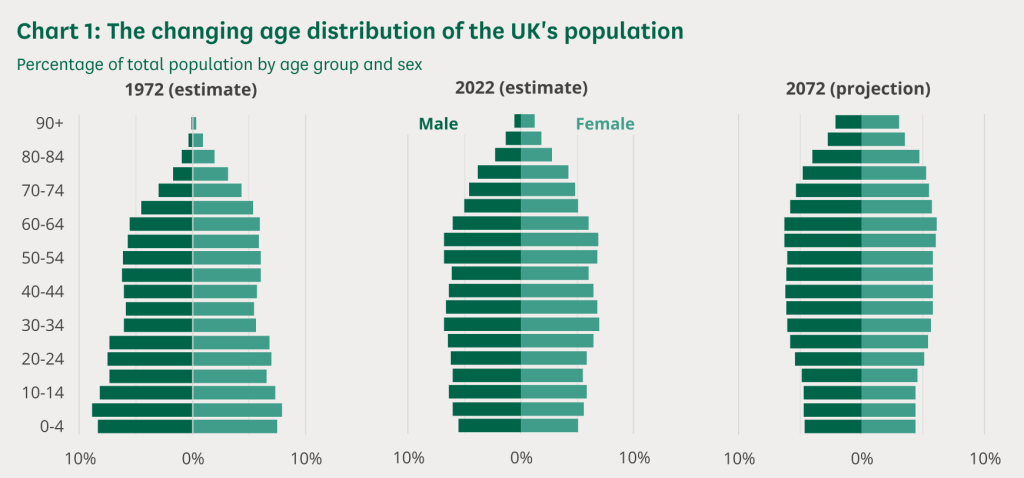
Chart: the UK population by age. Source: House of Commons Library
Population change is one of several factors that can affect housing demand, alongside housebuilding, interest rates and incomes. It does not guarantee that prices will rise in any particular area.
So, is it worth buying a house in the UK?
There is no single answer that fits everyone. Whether buying makes sense depends on your circumstances: how long you plan to stay, the size of your deposit, what you can afford, the upfront costs (deposit, any stamp duty or equivalent tax, legal and survey fees) and the ongoing costs of owning (mortgage interest, maintenance, insurance and any service charge or ground rent), compared with the rent you would otherwise pay.
It is also worth being clear about the risks. House prices can fall as well as rise, your payments may change when a deal ends, and your home may be repossessed if you do not keep up repayments on your mortgage.
Before you decide, check how much you may be able to borrow and read our article on whether a mortgage in the UK pays off.
FAQ
Frequently asked questions
Is it cheaper to rent or buy in the UK?
It depends on your circumstances. Compare the rent you would otherwise pay with how long you plan to stay, the size of your deposit, what you can afford, the upfront costs (deposit, any stamp duty or equivalent tax, legal and survey fees) and the ongoing costs of owning (mortgage interest, maintenance, insurance and any service charge or ground rent). House prices can fall as well as rise, and your payments may change when a deal ends.
How do interest rate changes affect my mortgage payments?
On a fixed-rate deal, your monthly payment normally stays the same until the fixed period ends, so a change in Bank Rate does not affect it until you move to a new deal. On a tracker mortgage, the rate usually follows Bank Rate plus a set margin, so payments can go up or down during the deal. Illustration only (not a quote): on a £200,000 repayment mortgage over 25 years, a rate of 4% gives a monthly payment of about £1,056, while 5% gives about £1,169, roughly £114 a month more.
Do first-time buyers pay stamp duty?
First-time buyers in England and Northern Ireland pay no SDLT on the first £300,000 and 5% on the portion from £300,001 to £500,000; the relief is not available if the price is above £500,000. Scotland has Land and Buildings Transaction Tax (LBTT) and Wales has Land Transaction Tax (LTT), with their own rates and reliefs.
Will UK house prices keep rising?
Nobody can reliably predict it. According to the UK House Price Index, the average UK house price was £273,000 in July 2026, 1.4% higher than a year earlier. House prices can fall as well as rise, and population change does not guarantee that prices will rise in any particular area.