
TL;DR
In short
- A mortgage offer is not a judgement of whether the area suits you or your family.
- Before buying, check local crime data, the standard of local schools, the local economy and flood risk.
- Recorded crime rates vary widely between neighbourhoods, so check the specific area, not just the town or city.
- A low property price does not necessarily mean a good deal – it may reflect these risks.
A property purchased to provide a home for you and your family should be a place where everyone feels safe, children have access to a high standard of education, and the location itself genuinely improves your quality of life. Equally important is long-term financial security – buying a home that is depreciating in value can expose the owner to the risk of negative equity, i.e. a situation where the property’s value falls below the amount of the mortgage.
To help you make an informed decision, we have prepared an article discussing the key factors that could make buying a house in a particular location a poor investment.
Does a lender’s approval of a mortgage mean the purchase is a sound investment?
Whether a lender agrees to grant a mortgage for a particular property should not be the sole indicator of whether the purchase is a sound investment. Of course, lenders sometimes decline a mortgage application because of the property’s characteristics or location.
In many cases, the lender will agree to grant a mortgage even though the property in question may cause you many problems or expose you to financial difficulties. Lenders assess whether you can afford the loan and whether the property is acceptable security; the lender’s valuation is not a survey and does not judge whether the area suits you or your family. You must take care of your family’s safety and your quality of life yourself – no one will stop you from buying a house in a noisy or poorly connected neighbourhood, and the same applies to flats in areas with a high crime rate.
Therefore, before you buy a property, you should carry out proper research into the location of your potential home.
What risk factors should you consider when buying a house in the UK?
Crime rate
One of the most important factors that significantly reduces the appeal of a particular location is a high crime rate. When considering your family’s safety in your chosen neighbourhood and a long-term financial commitment, it is definitely worth analysing the crime rate in the area. Bear in mind that the number of thefts can even affect the cost of your car insurance premiums.
There are several sources from which you can obtain information. One of them is official government websites, such as:
-
UK Police Crime Map – a website dedicated to statistics on various crimes occurring in specific areas. Using the search function, you can check a specific neighbourhood in England and Wales;
-
in the case of Scotland, finding information will be slightly more difficult, as there is no interface as straightforward as that of the rest of the UK, but the information is still available on the Scottish Police website. Alternatively, you can find various summaries and interpretations of the data online, e.g. datamap-scotland;
-
Office for National Statistics (ONS) – the website of the UK’s largest independent statistical office.
In addition to official statistics, information on crime in a given region can also be found on online forums such as Reddit or Mumsnet, where users often share their experiences of everyday life in specific towns and cities. There is also nothing to stop you from asking members of the local community for their opinions yourself.
However, you should bear in mind that information posted on forums is not always entirely reliable. For this reason, it is best to treat it merely as supplementary information, and to base key decisions primarily on official and verified data.

The most dangerous places to live in the UK
Recorded crime rates can be higher in large cities and town centres, but they vary widely between neighbourhoods. Remember that choosing where to live is a very local decision, not one that applies to the whole city, so it’s better to check each neighbourhood in detail.
For example, among London boroughs, Westminster recorded the highest crime rate, at 366.9 offences per 1,000 people in Metropolitan Police data for May 2024 to May 2025, followed by Camden at 186.4 per 1,000 (eufy analysis).
Sources: eufy.com
When we look at the statistics, the variation can be quite significant – for example, in Bradford, ranked the most dangerous city in the UK in a Security Journal UK analysis of 2023 recorded crime (158 crimes per 1,000 residents), you could consider moving to the Wharfedale area of the Bradford district, where the recorded crime rate in 2024 was around 41.4 offences per 1,000 people.
When choosing the location of your new home, you should take the time to analyse crime levels in your chosen areas in detail. This can help you find a safer, quieter neighbourhood, even in cities with a bad reputation. However, it is worth weighing this up against other criteria – such as the local job market, access to schools and the number of shops.

Standard of education
Assessing the standard of educational institutions in a given location is crucial for two reasons. Firstly, this obviously has a direct impact on your children’s educational journey. If schools offer a low standard of teaching, they may fail to provide suitable conditions for your children’s development and expose them to difficulties arising from inadequate educational support. Even if you manage to find a suitable school for your child further away from home, long daily commutes can reduce your family’s quality of life, making such a solution less practical.
Furthermore, the standard of local schools is a factor that significantly influences the property market in a given area. Many parents are prepared to pay more to live near well-rated schools, so homes near lower-rated schools may attract less demand. As a result, when you decide to sell the house, it may be much more difficult.
Although there is a chance that the situation will improve over the years, buying a house in an area with poor educational facilities carries a financial risk – if the quality of schools and the general standard of the neighbourhood do not improve, the property’s value may rise more slowly than in other areas, and in extreme cases may even fall. Therefore, even if you do not have or are not planning to have children, buying a house in such a location is still risky.
To assess the standard of educational establishments in a particular area, it is best to consult the reports published by Ofsted (the Office for Standards in Education, Children’s Services and Skills), the government body that inspects education and children’s care services in England. Scotland, Wales and Northern Ireland have their own school inspectorates.
Economic and development prospects
Some buyers consider properties in different towns or neighbourhoods depending on their budget, property prices, the homes available, local amenities and their personal circumstances. When choosing a place where you plan to spend hundreds of thousands of pounds on a house, it is worth thinking more broadly than just about your current job.
Some UK towns have faced long-term economic challenges after the decline of local industries or tourism – such places may be attractive because of low property prices, but in the long run they may not offer the prospects your family needs.
There are several good examples of such towns and cities:
-
Blackpool – a town on the Lancashire coast. For decades, the town was a popular holiday resort, which largely provided it with income and jobs. Following the decline in domestic mass tourism, many resorts went out of business and their employees had to retrain. As a result of these changes, the town began to struggle with economic and social challenges in some neighbourhoods;
-
Middlesbrough – a town on the River Tees in North East England. Middlesbrough developed as a major centre of heavy industry, which formed the backbone of the local economy. In the second half of the 20th century, as heavy industry across Europe began to decline and factories started closing, the town began to lose stable jobs. Despite several attempts at regeneration, Middlesbrough continues to face economic and social challenges;
-
Burnley – a town situated halfway between Preston and Bradford – like Middlesbrough, Burnley was hit hard by the economic changes of the 20th century. Once famous for its textile industry, it still faces economic and social challenges.
Of course, we’re not saying that you definitely shouldn’t buy a house in these towns, let alone move away from them. These examples simply highlight places whose heyday is now behind them, and living there could be risky both financially and in terms of overall development.
It is therefore a good idea to take a look at Census 2021 employment data (England and Wales) or local council reports and analyse the situation before making a final decision.

Flood-prone areas
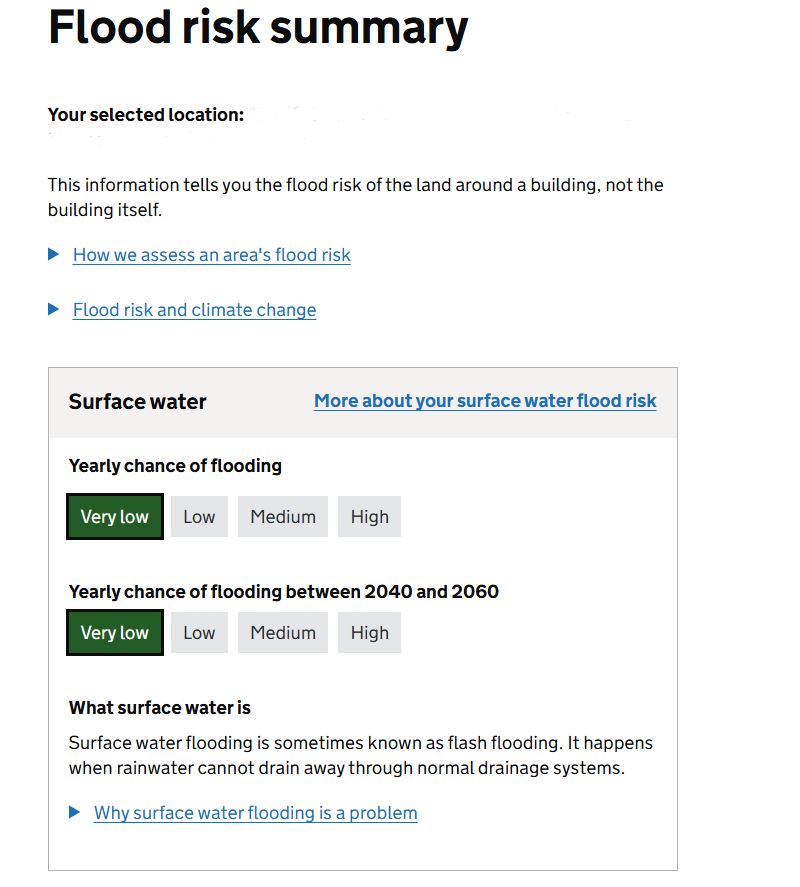
The Environment Agency estimates that around 6.3 million properties in England are in areas at risk of flooding from rivers, the sea or surface water. Before you buy a house at a particular address, look into the flood risk. In England, check the area’s long-term flood risk with the GOV.UK ‘Check long term flood risk’ service (it shows risk for an area, not an individual property); Scotland, Wales and Northern Ireland have separate services from SEPA, Natural Resources Wales and NI Direct. If it shows a ‘high’ risk, you should think twice about your decision. Even if a lender is willing to offer a mortgage on such a property, flooding can cause serious damage and disruption, so it is worth getting a buildings insurance quote before you commit.
Summary
There are several key factors you should consider before buying a house in the UK. Bear in mind that a low property price does not necessarily mean a good deal; it may be a sign of an unsafe neighbourhood, a risk of flooding, or a low standard of local services.
FAQ
Frequently asked questions
Does a mortgage offer mean the property is in a good area?
Not necessarily. Lenders assess whether you can afford the loan and whether the property is acceptable security; the lender’s valuation is not a survey and does not judge whether the area suits you or your family.
How can I check crime levels in an area?
On police.uk, you can check a specific neighbourhood in England and Wales. For Scotland, crime data is available on the Police Scotland website.
How can I check flood risk before buying?
In England, check the area’s long-term flood risk with the GOV.UK ‘Check long term flood risk’ service (it shows risk for an area, not an individual property); Scotland, Wales and Northern Ireland have separate services from SEPA, Natural Resources Wales and NI Direct.
Why do local schools matter even if I do not have children?
Many parents are prepared to pay more to live near well-rated schools, so homes near lower-rated schools may attract less demand. This can make selling the property harder.