
TL;DR
In short
- Mortgage rates are strongly influenced by the Bank of England’s Bank Rate: lenders usually charge more when it rises and less when it falls.
- Nobody can say for certain where mortgage rates will go next, because Bank Rate decisions depend on inflation, the wider economy and events abroad.
- Over 5-10 years, rates could fall for a while and then rise again, but no one can predict the path with confidence.
- Over a 30-year mortgage your personal circumstances may change a lot, and rates may be less volatile than in the past, although this is not guaranteed.
- Whether now is a good time to take out a mortgage depends mainly on your own circumstances, so it is worth comparing current deals with an adviser before deciding.
As a legally operating credit broker in the UK, we must inform our customers about the risk of interest rate increases and, consequently, increases in their mortgage instalments. Although this seems obvious, few people consider the actual likelihood of such an event occurring. For this reason, in today’s post, we will examine the prospects for borrowers over a period of several years and several decades.

Please note that anything that is not described as a quotation or supported by specific statistics should be interpreted as the personal opinion of the author of this article. Like everyone else, we may simply be wrong. However, we strive to base our beliefs on scientific views and economic data.
Why do mortgage interest rates change at all?
Many people are unable to give a concise answer to this question, when in fact it is quite simple. Mortgage rates are strongly influenced by the Bank of England’s Bank Rate: when it rises, lenders usually charge more on loans, and the reverse when it falls. Bank Rate is a tool used to control lending in the economy. When interest rates are high, borrowing becomes more difficult. At that point, the economy slows down and inflation falls. However, people can afford less than before the rate rise. When rates are lowered, borrowing becomes easier, but rates that stay too low for too long can push inflation up and cause a wave of price increases.
Although we could write a book on the role of interest rates, let us limit ourselves for now to saying that low interest rates tend to stimulate the economy and can raise inflation, while high interest rates tend to have the opposite effect. For this reason, our forecasts will be influenced primarily by economists’ forecasts.
Will mortgage interest rates rise over the next two years?
As you might expect, forecasting interest rates is easier the shorter the time horizon. Of course, unexpected events can still happen within two years.
Nobody can say for certain where mortgage rates will go next. Bank Rate decisions depend on inflation, the wider economy and events abroad, and economists’ forecasts change often. You can check the current Bank Rate and the latest inflation figure on the Bank of England’s website.
Stable interest rates make mortgage instalments more predictable, which makes it easier to plan expenses. The risk of negative equity depends mainly on the property’s value compared with what is still owed on the mortgage.

What will happen to interest rates in the next 5-10 years?
When we talk about a time horizon of a decade, forecasting becomes very difficult. On the one hand, a period of economic difficulty followed by a recovery is quite possible over such a long period. On the other hand, however, 10 years is still not enough to be able to talk about long-term trends that can be observed over a period of twenty, forty or fifty years.
In our opinion, rates could fall for a while and then rise again, but no one can predict the path with confidence. It is difficult to give specific figures for the next decade.
How will the interest rate on my mortgage change over 30 years?
Thirty years is a very long time – during that period, absolutely anything can happen, including a change of job, the arrival of a new baby, or even the death of the borrower. Although your personal life is likely to undergo enormous changes, in economic terms, the future does not have to be so turbulent.
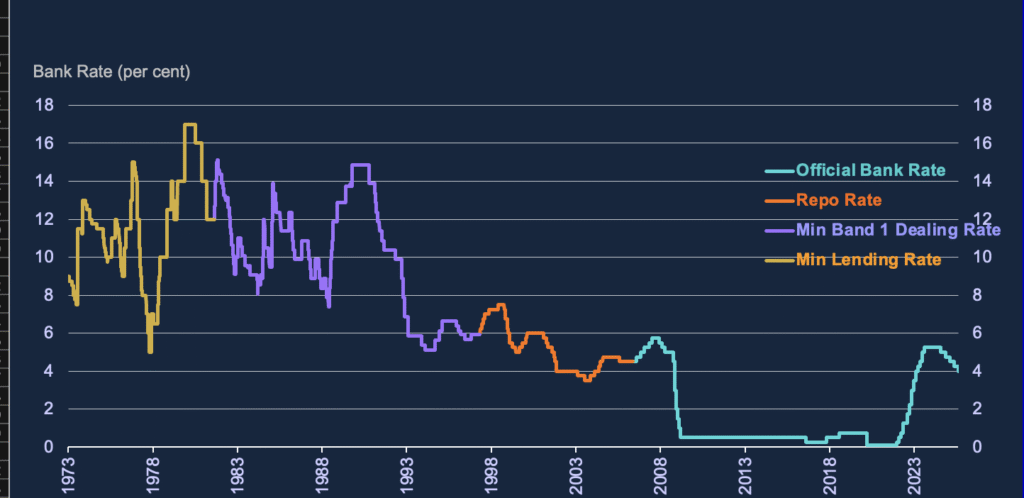
Source: Bank of England
Economics, like any science, is evolving. The Bank of England and other central banks have learned a lot about controlling inflation, which in our opinion may make large swings in interest rates less frequent than they were 20 or 30 years ago. However, the rises between December 2021 and August 2023 show that sharp changes can still happen.
Although absolutely anything could happen in the future, we think mortgage rates may be less volatile in the long term than in the past, but this is not guaranteed.
So what should I do? Is now a good time to take out a mortgage?
We cover this question in more detail in a separate article. For the purposes of this post, let us just note that whether now is a good time to buy depends mainly on your personal circumstances – your income, deposit, job security and plans – rather than on trying to predict interest rates. It is worth comparing current deals with an adviser before deciding.
House prices can fall as well as rise, so buying a property should be a long-term decision that fits your budget.
FAQ
Frequently asked questions
Why do mortgage interest rates change at all?
Mortgage rates are strongly influenced by the Bank of England’s Bank Rate: when it rises, lenders usually charge more on loans, and the reverse when it falls. High rates tend to slow the economy and inflation, while low rates tend to have the opposite effect.
Will mortgage interest rates rise over the next two years?
Nobody can say for certain. Bank Rate decisions depend on inflation, the wider economy and events abroad, and economists’ forecasts change often, so check the Bank of England’s website for the current Bank Rate and inflation.
What will happen to interest rates in the next 5-10 years?
Forecasting over a decade is very difficult, and a period of economic difficulty followed by a recovery is quite possible. In our opinion, rates could fall for a while and then rise again, but no one can predict the path with confidence.
How will the interest rate on my mortgage change over 30 years?
No one can say. Over 30 years your circumstances may change a lot, for example through a change of job or a new baby. In our opinion, rates may be less volatile in the long term than in the past, but this is not guaranteed.
So what should I do? Is now a good time to take out a mortgage?
It depends mainly on your personal circumstances – income, deposit, job security and plans – rather than on trying to predict interest rates. It is worth comparing current deals with an adviser before deciding, and remember that house prices can fall as well as rise.