TL;DR
In short
- The debt-to-income ratio (DTI) is the ratio of your monthly debt repayments to your gross monthly income.
- The main debts that count are mortgages, buy-to-let mortgages, loans, lease and hire purchase instalments, and money borrowed on credit cards; how a credit card counts varies by lender.
- DTI is an important factor in the creditworthiness assessment made by lenders’ underwriters, alongside your credit history, income and deposit.
- Lender DTI limits vary: many lenders prefer a DTI below roughly 50%, and some set no fixed maximum. Many lenders also cap borrowing at around 4 to 4.5 times income (loan-to-income); this is a separate measure from DTI.
- Your debt-to-income ratio does not directly affect your credit score, because your income is not held on your UK credit file.
Banks look at a great many factors when assessing affordability. One of them is the debt-to-income ratio (DTI). Its value signals your ability to repay and, in a sense, determines the lender’s level of risk.
What is the debt-to-income ratio?
Debt-to-Income Ratio is the ratio of your monthly debt repayments to your gross monthly income. So if your DTI is 20% and you earn £5,000 a month before tax, the total of your monthly instalments on loans, advances and leases will be £1,000.
DTI = (total monthly debt repayments ÷ gross monthly income) × 100
What commitments affect the DTI?
Let us list the most important ones:
-
Mortgages;
-
Loans;
-
Lease and hire purchase instalments (leases);
-
Funds borrowed on credit cards.
By convention, fixed liabilities that are not loans do not count towards the Debt-to-Income ratio - so we do not include private school tuition fees, subscriptions, etc. Some lenders base a credit card commitment on the outstanding balance rather than the credit limit – for example, by assuming a monthly payment of 3% or 5% of the balance – so how a card counts towards DTI varies by lender.

Why is the Debt-to-Income ratio important?
The Debt-to-income ratio is an important factor from the perspective of the creditworthiness assessment made by bank underwriters. The DTI ratio is also important in terms of credit risk.
Debt-to-Income and affordability
Lender DTI limits vary: many lenders prefer a DTI below roughly 50%, and some set no fixed maximum. DTI is one of the factors that influence the amount you can borrow. Many lenders also cap borrowing at around 4 to 4.5 times income (loan-to-income); this is a separate measure from DTI and part of the wider affordability assessment.
If a large part of your income is already taken up by loan repayments, credit card repayments and other obligations, there is less room left for mortgage repayments within a lender’s DTI limit. It does not matter what proportion of your earnings you allocate to savings, for example - the DTI is set at a relatively low level because, if interest rates rise, your mortgage instalments could increase dramatically, potentially even exceeding your income. This has happened before.
Someone with annual earnings of £200,000 will need a smaller proportion of their income to cover basic living costs compared to someone earning £35,000.
Debt-to-income and credit risk
Your Debt-to-Income ratio does not directly affect your credit score. However, it is a very important indicator from a risk assessment perspective - if your DTI changes frequently, a credit analyst may infer that your financial situation is not very stable. Similarly, by keeping your DTI low and stable, you give evidence that you are managing your money well and not taking on all possible liabilities.

Logic would dictate that a low Debt-to-Income Ratio is evidence of prudent and responsible money management. People with low borrowing needs tend to have their finances under control.
What amount of debt-to-income ratio is considered good?
It is very difficult to give a specific DTI figure that can be considered adequate. In theory, it is of course 0%, but it is hard to expect a UK adult to have no liabilities. The bands below are general guidance only.
In our opinion, a debt-to-income ratio of less than 20% is a very good result. If your liabilities take up less than 20% of your gross monthly income, lenders are generally comfortable with this level, although they also look at your credit history, income and deposit. This is also the level at which you will be able to withstand a rise in interest rates in peace. Even if your total instalments were to double, your DTI would still be below 40%.
Debt-to-income of between 20% and 40% is also a good result. With a DTI in this range you have a good chance of approval, as only a handful of mortgage lenders set a maximum DTI below 40%, although lenders will also look at the rest of your application.
Debt-to-income of 40% to 60% suggests that the situation needs to be worked on. Above around 50% DTI, fewer lenders may be willing to lend and the terms on offer may be less favourable. In our view, you should do everything you can to get your DTI down to around 40% before applying for a mortgage. As well as having access to better deals, you will also gain a much higher level of mental comfort.
Debt-to-income of between 60% and 80% is an alarming score that can severely limit the availability of credit offers. Relatively few lenders may be willing to lend, particularly with a small deposit, and analysts will also be more meticulous when it comes to assessing your credit score.
Debt-to-income above 80% makes obtaining a mortgage a challenge. Banks are wary of working with people with high levels of debt, as even small changes in interest rates can lead to their insolvency and delayed instalments.
How does debt-to-income vary with the level of interest rates?
Bank Rate rose to 5.25% in 2023 and has since been cut; check the Bank of England website for the current rate. Rates in recent years have been much higher than during 2009–2022. Therefore, when taking out a mortgage, you must expect the risk of an increase in interest rates.
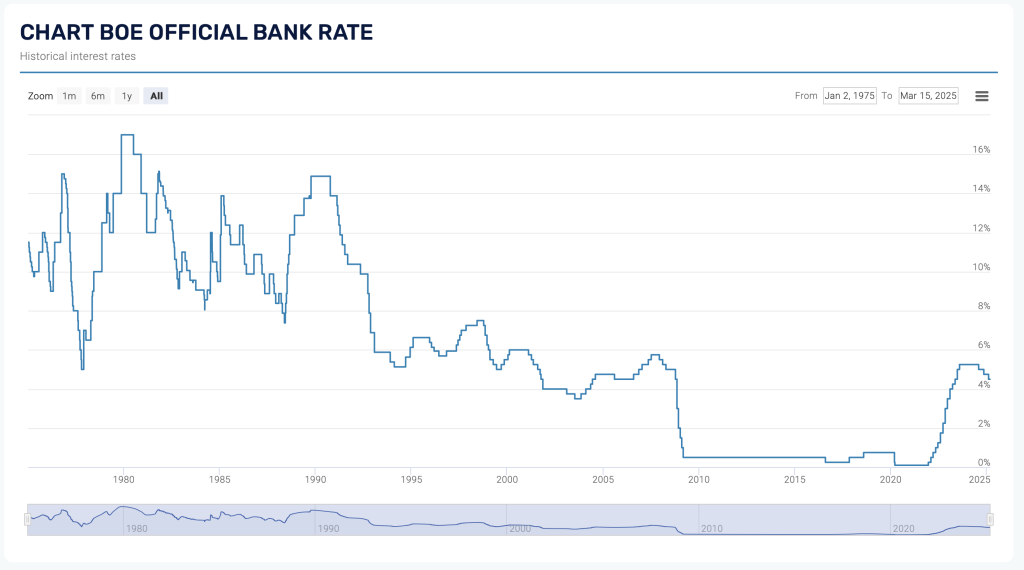
Source: global-rates.com
In fact, one does not need to go far back in history to see how painful changes in Bank of England policy can be. To illustrate this, let us use an example. The example is illustrative only and the interest rates in it are hypothetical.
In January 2021, Anna and Maximilian took out a £190,000 mortgage with a £10,000 or 5% deposit. Initially, the interest rate was 2.6% and was frozen for 2 years. The repayment of the entire commitment was spread over 25 years. Anna and Maximilian were then paying instalments of £861.97 per month. Thanks to the low interest rate, they managed to repay £11,081, so their mortgage balance was £178,919.
When their mortgage agreement came to an end two years later, the situation was already very different - interest rates had risen, making the available offers much less favourable. Anna and Maximilian decided to remortgage and, despite a much lower LTV, the interest rate was already 4.2%. The instalment was already £1,012.06. Between January 2023 and January 2025, they managed to reduce the mortgage balance by just £9,643, so it had fallen to £169,276.
In January 2025, Anna and Maximilian remortgaged again. They did not want to extend the repayment period, so they took out a 21-year loan at an interest rate of 5.7%. The instalment increased again - this time to £1,153.53. In January 2027, their mortgage balance would be £160,414, so they would only manage to repay £8862 over two years.
Between January 2021 and January 2027, Anna and Maximilian would repay £29,586 of capital. In a hypothetical scenario where interest rates would have remained at the same level as in January 2021, they would have been able to repay in six years…. £35,047.
Let’s also compare the instalments. Assuming fixed and low interest rates, Maximilian and Anna would give £62,061.84 to the bank. In this scenario, however, it would be £72,661.44. The difference is over £10,000! It is worth noting that with each increase in the monthly instalment, the Debt-to-Income ratio of Maximilian and Anna increases.

If you are curious about how your mortgage instalments will develop in the future, it is worth using the mortgage calculator created by Moneyhelper. We have also used it.
You can read more about the risks associated with interest rate changes in the article entitled ‘How do changes in interest rates affect mortgage repayments?’.
Mortgage stress test
The above example was not intended to scare you - it is simply about realising that it is not worth getting used to your current mortgage rate.
Lenders must still stress test affordability under the FCA’s interest rate stress test rule, taking account of likely future interest rate rises when checking whether you can afford the mortgage. The FCA’s rule (MCOB 11.6.18R) does not set a maximum debt-to-income ratio or prescribe which interest rate lenders must use in the stress test.
Until 1 August 2022, a Bank of England Financial Policy Committee recommendation asked lenders extending more than £100 million of residential mortgages a year to check whether borrowers could still afford their mortgage if, at any point in the first five years, their rate were 3 percentage points higher than the reversion rate in the mortgage contract. The FCA’s own stress-test rule (MCOB 11.6.18R) still applies, but it does not prescribe a specific stress rate.
Ways to reduce the debt-to-income ratio
At the outset, let us point out - the ways in which debts are managed should depend on several factors, such as:
-
Your age – The available term depends on the lender’s criteria, your age at the end of the mortgage and your income now and in retirement. A longer repayment term can reduce monthly payments but increase total interest.
-
Your income and the potential to increase it - if your job allows you to get a promotion or take overtime, you are in a much better position than someone who is no longer able to earn more in their current job;
-
Debt structure - you’ll experience a much bigger change if you’re paying off loans with high interest rates, because by getting rid of them, you’ll reduce your repayment expenses a lot more;
-
The current market situation - current interest rates have a big impact on your debt management strategy;
-
Your expenses in the future - paying off debts at the expense of savings is not always advisable.
Extension of the repayment period of loans and credits
Changing the repayment schedule of a loan or credit usually lowers your monthly repayments, and so your DTI, if the lender agrees - you will end up having more time to pay back all the capital, so the instalments will be lower. Unfortunately, this translates into a higher total cost of the loan, as interest will take longer to accrue.

Before extending a mortgage term, assess your whole budget and retirement plan, including expected income, spending and savings. The appropriate term depends on your individual circumstances.
Increase in earnings
It should come as no surprise to anyone that your Debt-to-Income will drop if you start earning more. Taking on overtime or changing to a better-paid job will definitely help, and using the increase to pay off your loans will be even more effective.
This way of reducing Debt-to-Income will not work if you are at your peak or your family situation does not allow you to spend more time at work.
Priority repayment of loans and credit cards
If your debts consist of a lot of small loans, for example for a phone, TV or computer, it is worth putting as much money as possible into paying them off quickly. Before repaying a loan early, compare any early settlement charge with the interest you would save.
Always start overpaying on loans with the highest interest rates. The second criterion is the time left to repay - if you have five instalments of £20 each left, it’s worth paying the whole thing back straight away.
Remortgaging regularly
If you already have a mortgage, remortgaging can help you lower your Debt-to-Income ratio. Before you switch, weigh arrangement fees, legal costs and any early repayment charges against the savings. You can also use the lower mortgage rates to shorten the repayment period while keeping the same costs as before.

Using financial surpluses to overpay loans
Not every moment is a good time to overpay your loans. If you know you’re going to need to fix the engine in your car in three months’ time, which will cost you £800, it’s not worth focusing on paying off your loans quickly - it’s better to put some money aside so you don’t have to borrow to fix your car later. Savings can give you a buffer, but lenders still assess your DTI.
If you don’t plan on spending anytime soon and you have some money for a rainy day, allocating surplus funds to overpaying your mortgage, paying off credit cards or loans can reduce the interest you pay, particularly on higher-interest debt. Before you do, check any early repayment charges or overpayment limits, and keep an emergency fund.
FAQ
Frequently asked questions
What is the debt-to-income ratio?
The debt-to-income ratio (DTI) is the ratio of your monthly debt repayments to your gross monthly income.
Which debts count towards DTI?
The main ones are mortgages, buy-to-let mortgages, loans, lease and hire purchase instalments, and money borrowed on credit cards. How a credit card counts varies by lender: some base it on the outstanding balance rather than the credit limit.
Why does DTI matter for a mortgage?
DTI is an important factor in the creditworthiness assessment made by lenders’ underwriters. It is one of the factors that influence how much you can borrow, alongside your credit history, income and deposit.
What DTI do UK mortgage lenders accept?
Lender DTI limits vary: many lenders prefer a DTI below roughly 50%, and some set no fixed maximum. Many lenders also cap borrowing at around 4 to 4.5 times income (loan-to-income); this is a separate measure from DTI.
Does DTI affect my credit score?
Your debt-to-income ratio does not directly affect your credit score, because your income is not held on your UK credit file. However, how much of your available credit you use can affect your score.