TL;DR
In short
- Check your credit reports with Experian, Equifax and TransUnion: each may hold different information, and statutory access is free.
- A consumer score is an agency’s guide, not a universal UK score or a mortgage decision.
- Review your details, accounts, associations, public records and searches, then raise inaccuracies with the agency and data supplier.
- The screenshots below are a historic, hypothetical example. They cannot predict a lending outcome.
Checking your credit report before a mortgage application can help you spot inaccurate or out-of-date information and understand what a lender may see. A mortgage decision is not based on one universal credit score: lenders use their own criteria and assess affordability, including income, expenditure and existing commitments. Fees and whether they are refundable depend on the product and its terms.
Credit report and credit score: what is the difference?
A credit report is a record of information held about you by a credit reference agency (CRA). It can include your name and address history, credit accounts and payment history, financial associations, public records and credit searches. Experian, Equifax and TransUnion hold separate files, and lenders do not have to report to all three, so the information can differ.
A consumer credit score is a score calculated by a CRA or monitoring service from the information it holds. It is useful as a prompt to check your report, but it is not a universal UK score or a guaranteed indication of approval, interest rate or borrowing amount. Score ranges also vary between providers and can change over time. For more on the factors that can affect a credit profile, see how to improve your credit score.
How to check your credit report for free
You can request a free statutory credit report directly from each of the three main CRAs:
You will usually need to confirm your identity and address. A statutory report is not necessarily the same as a paid monitoring product and may not include a consumer score. Checking your own report does not reduce your credit score.
When you receive the reports, check that your name, date of birth and addresses are correct; that accounts, balances and payment records belong to you; that financial associations are accurate; that electoral-register and public-record entries are correct; and that recent searches make sense to you.
Optional credit-monitoring services
Paid services can make it more convenient to monitor reports or show a consumer score, but they are optional: you do not need a subscription to obtain statutory reports. For example, Checkmyfile displays its own consumer score using information from more than one CRA. Read the current terms and the offer shown before registering, as trial length, renewal and cancellation terms can change.
What does a historic credit report example show?
The screenshots below are from a hypothetical historic example prepared in May 2024. They illustrate the kinds of panels a multi-agency report may contain. They do not establish current product terms, the meaning of every status label, or how a lender would assess an application.
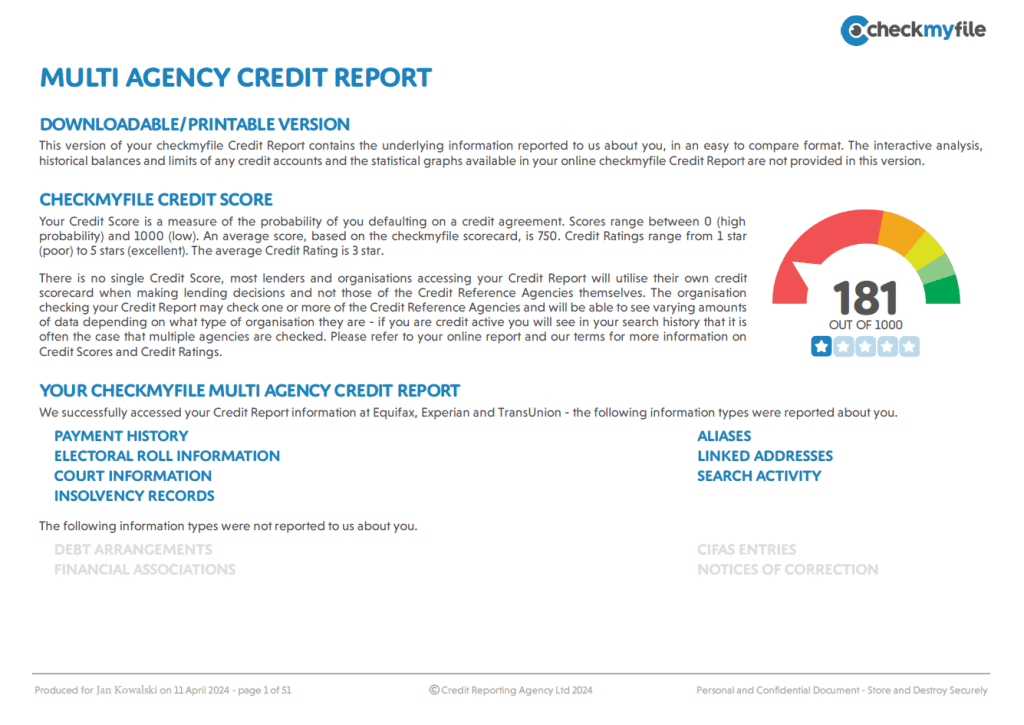
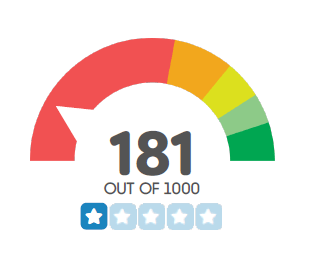
The overview includes a historic consumer score alongside report sections. A score is only one way a provider may summarise its data; the underlying entries are what you should check for accuracy.
Payment history
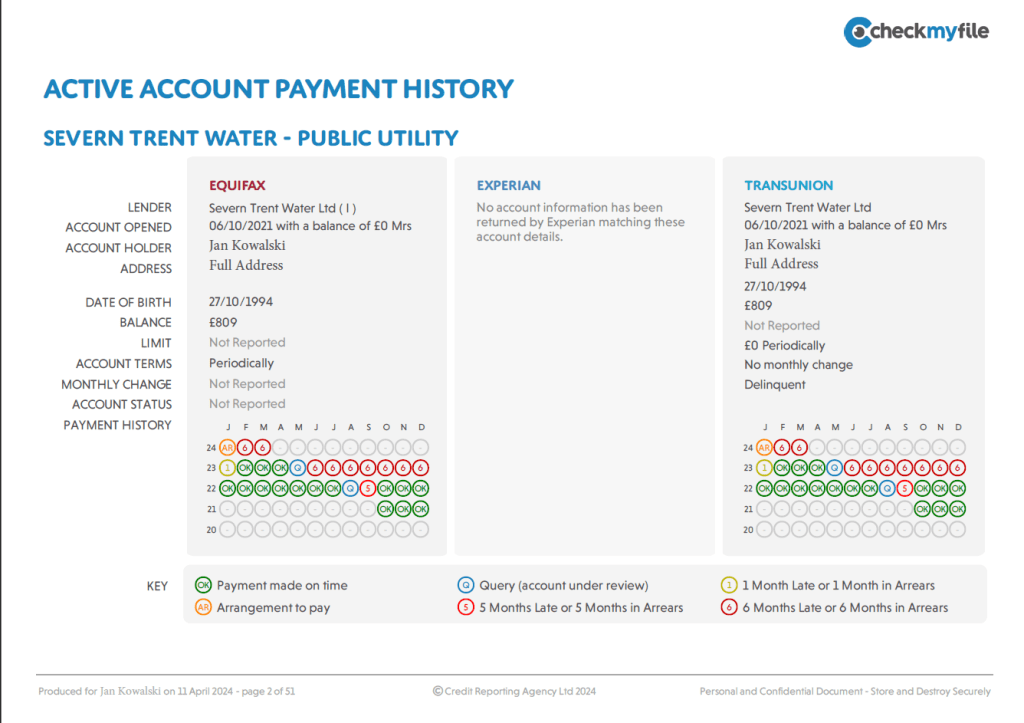
This panel compares three CRA columns: Equifax and TransUnion show payment history, while Experian says no matching account information was returned. If a payment record is wrong, identify the entry and contact both the relevant CRA and the organisation that supplied the data, with supporting evidence.
Keep copies of your request and responses, then recheck the report after a correction is processed. A Notice of Correction can add context to an entry, but it does not remove it. If a data-accuracy issue remains unresolved, the ICO’s credit guidance explains possible next steps; an eligible complaint about a financial business may also be considered by the Financial Ombudsman Service. Accurate adverse information is not removed simply because it is inconvenient.
Closed accounts and payment records
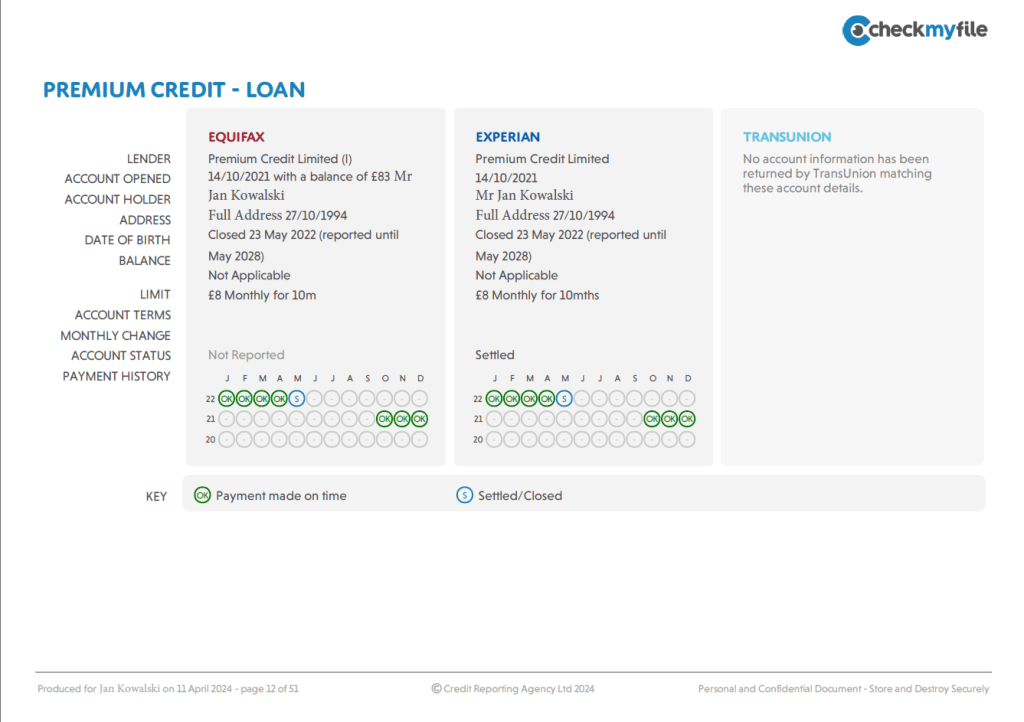
This example shows a closed loan and its reported payment history. Provider labels and symbols need to be read with that provider’s legend. Do not infer the full repayment history, score effect or a lender’s decision from a single status symbol.
Credit-card records
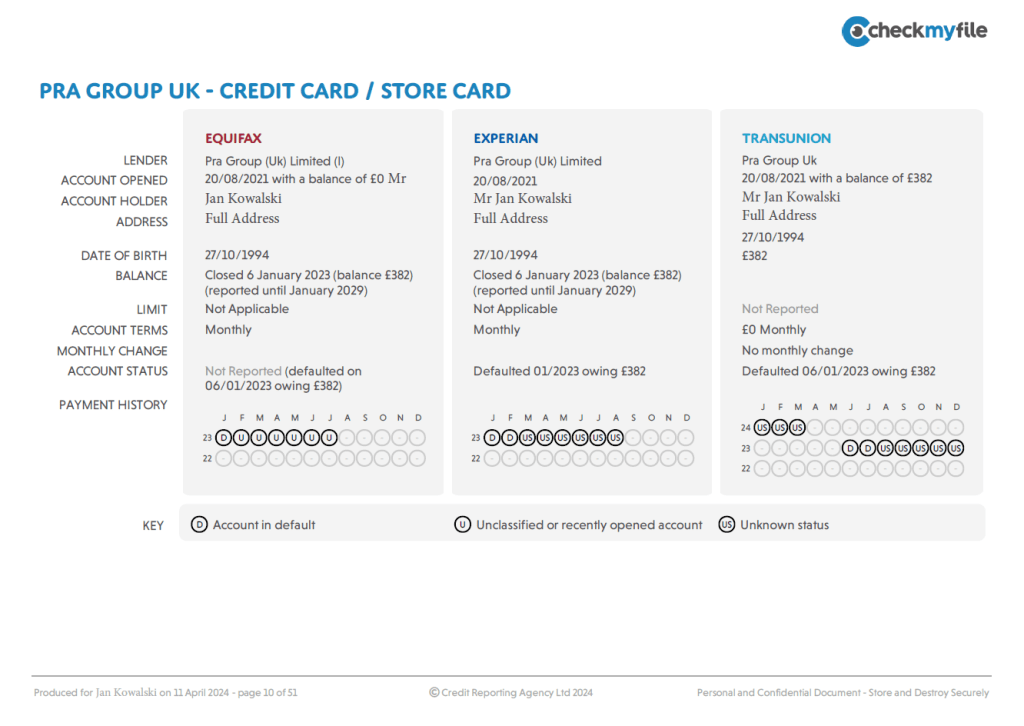
This panel illustrates that credit-card status records may differ across agencies. There is no universal rule that everyone should keep a fixed number of cards. Lenders and providers can consider repayment history, balances, available credit and other circumstances together.
Closing an unused account can change the proportion of your remaining available credit that you use, so it does not guarantee an improvement. Check the provider’s explanation of an unfamiliar label and challenge it only if the underlying information is inaccurate.
Register of electors
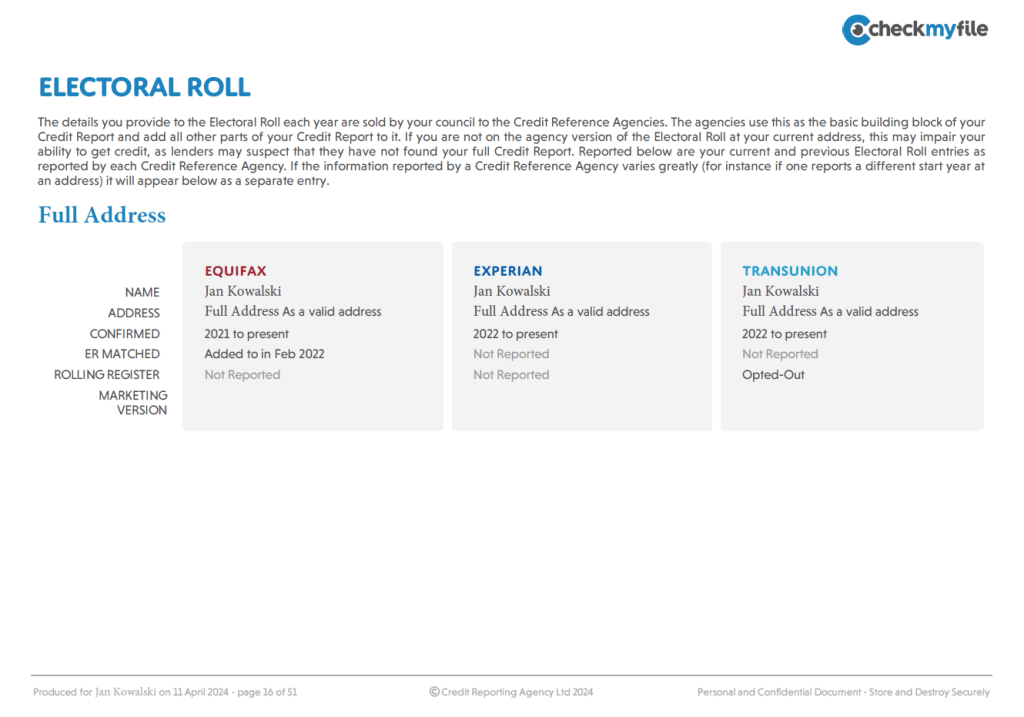
If you are eligible, registering to vote at your correct address can help with identity and address checks and may help your credit profile. Check whether you can register to vote rather than registering solely for credit purposes. Opting out of the open register does not remove an eligible person from the full electoral register used for credit checks.
Court judgments
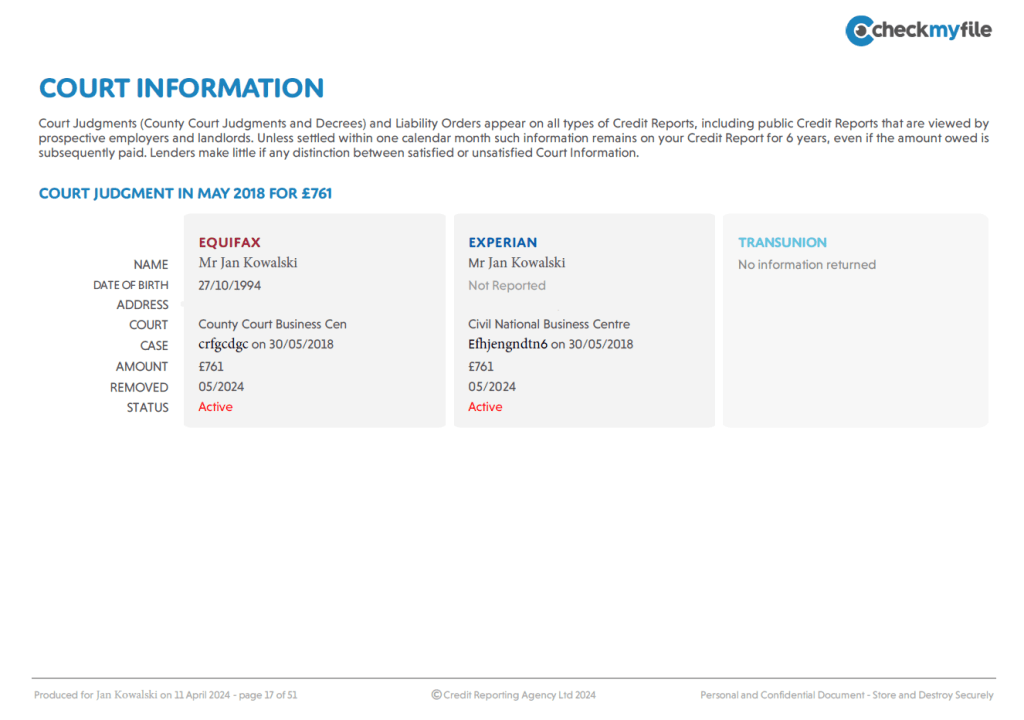
This historic example includes a court-judgment entry. In England and Wales, a county court judgment (CCJ) is normally recorded for six years from the judgment date. Paying it in full within one month can allow removal from the register; payment later can allow it to be marked as satisfied while it remains for the six-year period. If register information is wrong, raise it with the court. The end of a credit-file record does not by itself mean a debt has been paid or cancelled.
Court-record rules are not identical throughout the UK: Scotland uses decrees, and Northern Ireland has separate procedures. Check the route that applies where the judgment was made rather than assuming that an England-and-Wales rule applies everywhere.
Insolvency records
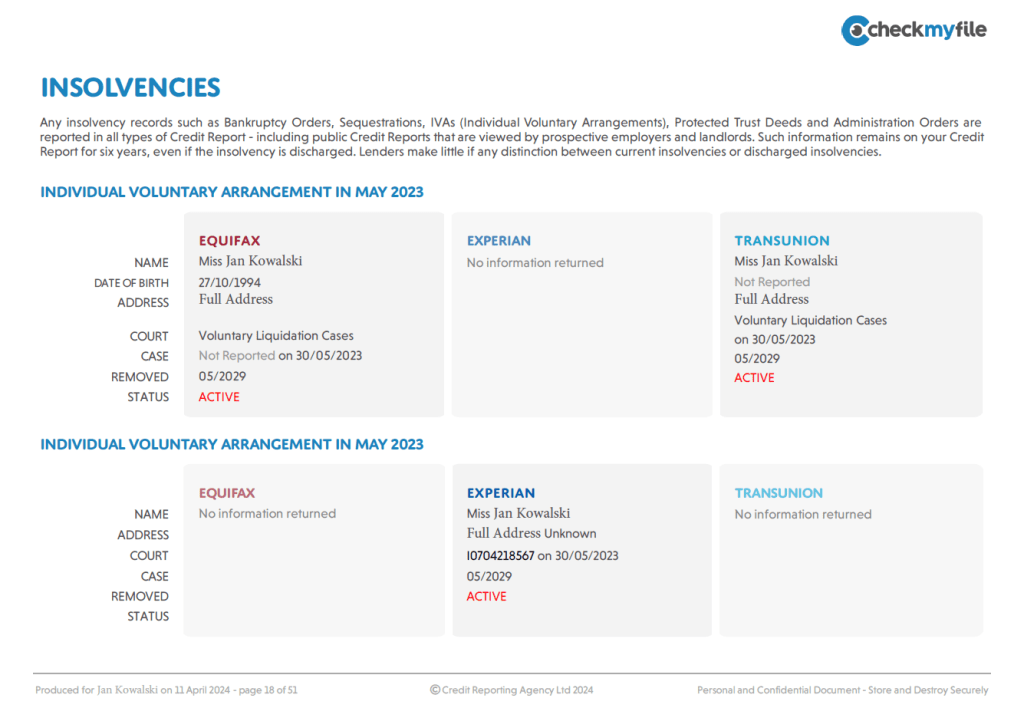
The example shows individual voluntary arrangement entries. Formal insolvency can have serious credit consequences, but its effect on a future mortgage application is assessed by each lender and is not fixed by a consumer score. Bankruptcy, discharge and the retention of records are different matters. In England and Wales, bankruptcy can remain on a credit file for six years from the bankruptcy date; Scotland uses the term sequestration, and Northern Ireland has its own procedure and register.
If you are worried about debt, seek free, independent debt advice before taking further credit. The MoneyHelper debt advice locator can help you find support.
Credit applications
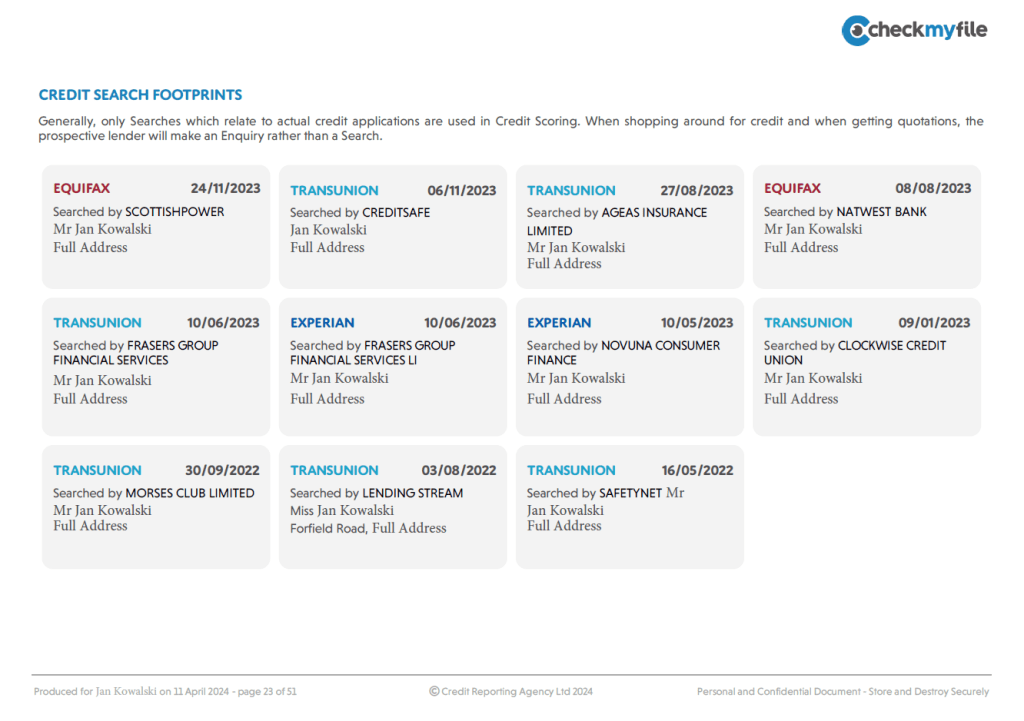
This example shows hard-search footprints. A hard search can affect a credit assessment, particularly if there are repeated applications close together, but a search does not show whether an application was approved, declined or what rate was offered. Different CRAs and lenders may retain or assess searches differently.
Before using an eligibility checker or agreement in principle, ask whether it uses a soft or hard search. Avoid unnecessary formal applications where possible, but do not assume a search alone determines the outcome.
Soft credit checks
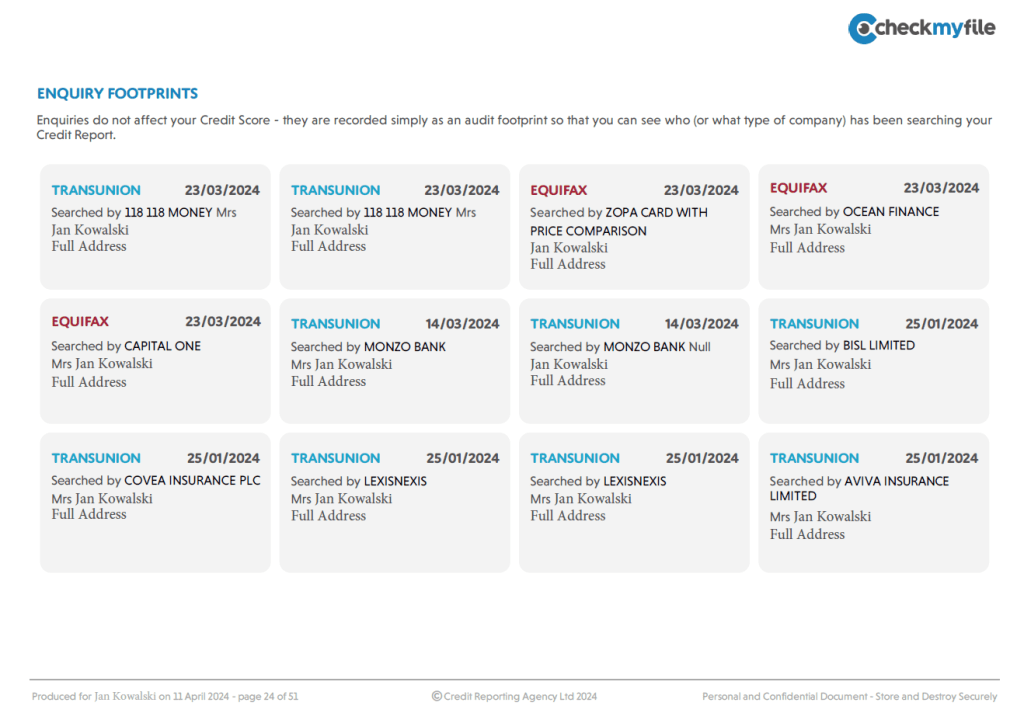
A soft search does not affect the consumer score shown by the CRA, and checking your own report is safe. The panel is an historic example of enquiry footprints; use the provider’s legend to understand a particular entry.
Practical steps before applying for a mortgage
Keep your report details accurate, pay agreed amounts on time where possible, and contact a creditor early if you are struggling. Manage financial commitments in a way that suits your circumstances, and avoid taking new credit simply to try to change a score. If you are building an emergency fund, base it on essential costs and priority debts rather than a fixed amount or a promised score increase.
If you are preparing a mortgage application, a broker or lender can explain the information it needs for its affordability assessment. Checking your reports first gives you time to correct genuine errors, but it cannot guarantee a decision.
FAQ
Frequently asked questions
What is a credit score?
A credit score is a number calculated by a credit reference agency or monitoring service from the data it holds. It is not a universal UK score and is not a mortgage approval decision.
How can I check my credit report for free?
You can request a free statutory report directly from Experian, Equifax and TransUnion. Check all three where possible because their files can contain different information.
Will checking my own credit report affect my score?
No. Checking your own credit report does not reduce your score. A lender’s formal application may use a hard search, so ask which type of search an eligibility tool or application will use.
What should I do if my credit report is wrong?
Contact the relevant credit reference agency and the organisation that supplied the information, with evidence of the error. Keep their responses and recheck the report. If the issue remains unresolved, consider the ICO guidance or an eligible Financial Ombudsman complaint.
Does a high credit score guarantee a mortgage?
A high consumer score does not guarantee a mortgage. Lenders use their own criteria and assess affordability, income, expenditure, existing commitments and other details of the application.